
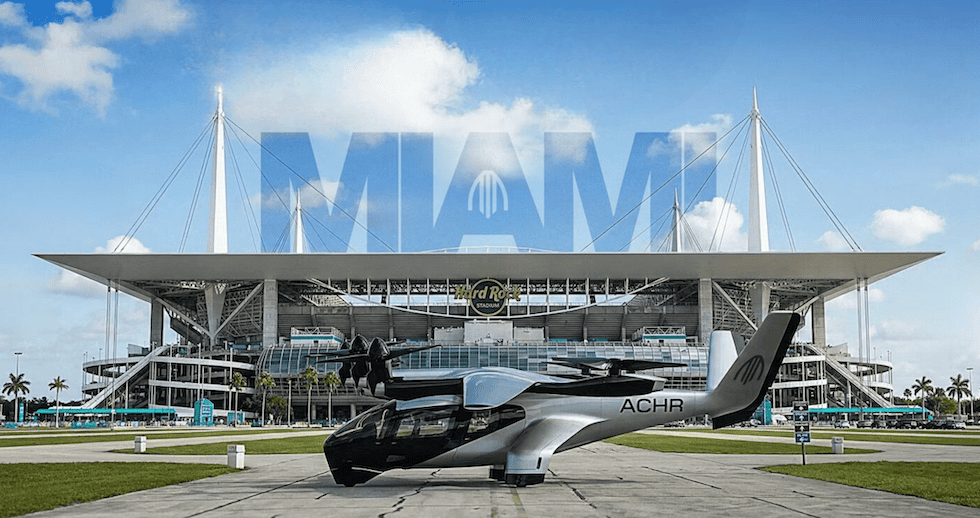
Miami plans to launch an electric air taxi network in 2026, an ambitious project that aims to transform minutes of congestion into 10- to 20-minute flights, connecting the city with its surrounding areas in a faster, more sustainable, and futuristic way.
When traffic clogs the avenues of South Florida, the solution for some might be to look above the city’s buildings.
That’s why Archer Aviation presented its plan to deploy an electric air taxi network in the Miami metropolitan area, Florida, promising to radically change urban mobility: flights of between ten and twenty minutes connecting Miami with Fort Lauderdale, Boca Raton, West Palm Beach, and the region’s main airports.
The heart of this project is the Midnight eVTOL, an electric vertical takeoff and landing (eVTOL) aircraft with a capacity for four passengers and a pilot, capable of reaching speeds of up to 240 km/h and covering distances of up to 160 kilometers.
Archer Aviation, the company behind the development of the electric air taxis, claims that operating it is as simple as driving an electric car, since many of the complex processes are automated, and that its design, with redundant propellers, motors, and batteries, aims to maintain safety even in case of malfunctions.
An ambitious project to improve mobility in Miami
The ambitious plan depends on both regulations and infrastructure: the network will require the construction of “vertiports,” takeoff and landing platforms attached to real estate developments, airports, and existing spaces such as stadiums or golf courses that will be adapted.
Although the company aims to launch its first flights in the summer of 2026, experts warn that full operation could take several years, as full certification and final infrastructure agreements are still pending.
If everything goes according to plan, what could currently be a commute of up to 90 minutes by road during rush hour will be reduced to a short flight of just a few minutes, freeing up streets and offering hope for a more agile, efficient, and less polluting urban transportation system.
If the project manages to overcome regulatory and infrastructure challenges, Miami could become one of the first cities in the world to integrate electric air taxis into its daily transportation system.
The initiative not only aims to reduce travel times and decongest roads but also to position the city as a leader in sustainable mobility.
For now, the plan is moving forward with high expectations and the promise that, in the near future, flying above traffic will cease to be a luxury and become part of everyday urban life.