
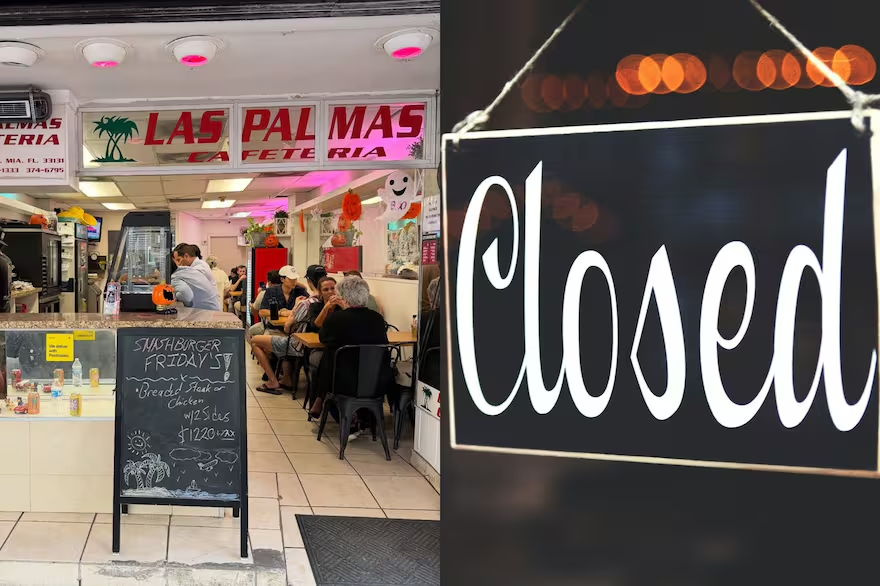
After nearly 45 years as a meeting place for office workers, tourists, laborers, and businesspeople in downtown Miami, the famous Cuban restaurant “Las Palmas” has closed its doors for good.
Las Palmas, a Latin icon in downtown Miami, has closed.
Mario Magalhaes, 31, inherited the business from his father nine years ago, before his passing. Regarding the closing day, which coincided with his father’s birthday, he recalled: “It was poetic, in a way.”
“It’s like a bad breakup,” he admitted in an interview with CNN. “To be honest, I’ve been kind of avoiding going back, walking past the place,” he added.
The closure was announced via a post on Las Palmas’ Instagram profile on November 10: “That’s it, folks! After 45 years serving the downtown Miami community, 9 of them under our management, the day has come for us to close our doors for the last time,” the post read, accompanied by a video highlighting the restaurant’s vibrant activity.
“We’ve overcome many ups and downs, all thanks to you. Without you, we wouldn’t have come this far. Thanks to you, we’ve been able to do so much: feed the homeless, raise funds for victims of natural disasters, for children with terminal illnesses, and so many other good causes,” the message concluded.
The rising cost of basic supplies hit Las Palmas hard. Magalhaes recounted: “A box of 15 dozen eggs, 180 eggs, went up in price just three months ago, in 2025, to US$132, when before that same box cost US$20.”
Despite the increased costs, he maintained the price of some products, like the small coffee, for cultural reasons. “It’s something that’s part of the culture, something very Miami, and it’s rare and abnormal to pay more than a dollar for a small coffee or an espresso in Miami,” he explained.
The drop in international tourism, essential for a restaurant located near the cruise port, was another determining factor.
“People are getting nervous about coming here; they’re afraid of being detained, you know?” the restaurateur explained.
Meanwhile, the Pew Research Center indicated in a report that 52% of Latinos fear that they, a family member, or a close friend could be deported, even if they are legal residents or citizens.
Magalhaes tried various measures to maintain the The business was afloat. He organized comedy nights, karaoke, outdoor parties, and collaborated with local artists and events like Miami Music Week. “We tried everything,” he said.
Despite his efforts, the combination of inflation and a drop in tourism made the restaurant unsustainable. The restaurant also supported social causes: it fed the homeless and raised funds for victims of natural disasters and children with terminal illnesses.
For Magalhaes, Las Palmas represented more than just a business. “I like to think that Las Palmas gave me a pulse of society. Anyone could come in: the doorman from the building next door or the owner of those very buildings.”
“It was beautiful because the ‘big shots’ could come, but it wasn’t pretentious. Everyone could be there; you never knew who would come in or who you’d talk to, and that was the beauty of it,” the now-former owner recalled.