
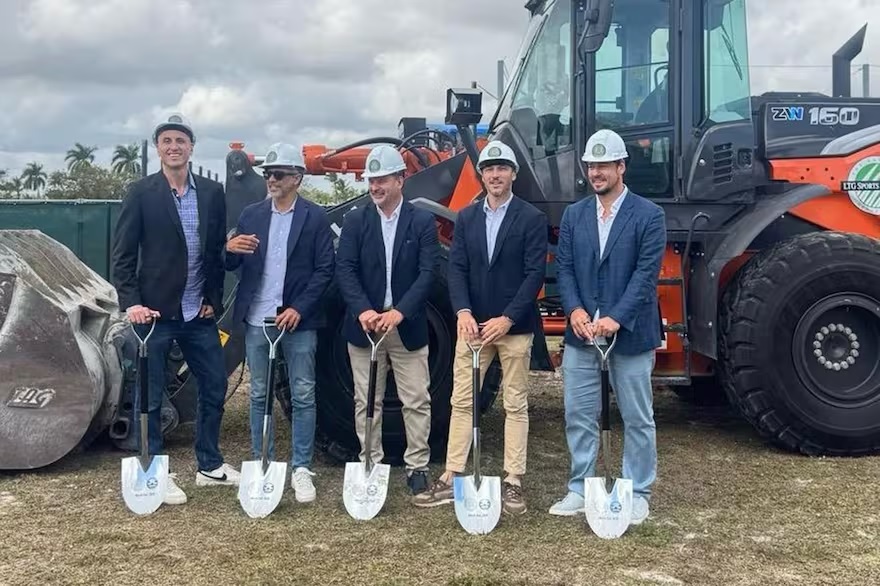
More and more elite athletes are looking to real estate as an investment opportunity. But a group of Argentine athletes decided to go a step further: The Sports Performance Hub complex will require a US$280 million investment and will be built on a plot of land spanning more than 37 hectares, which the group obtained through an 80-year lease with the City of Homestead, the second oldest city in the county and the gateway to the Everglades, about 40 kilometers from downtown Miami.
“There aren’t many projects of this type in the United States,” explains former basketball player (Spurs) Emanuel Ginóbili, one of the partners.
Other stars who have marked the history of Argentine sports are also joining the list of partners: Manu Ginóbili, former NBA champion basketball player; Juan Sebastián Verón, idol and current president of Estudiantes; Darío Sala, former goalkeeper who began his career at San Lorenzo; Pepe Sánchez, the first Argentine to play in the NBA; former tennis players Juan “Pico” Mónaco and Mariano Zabaleta; and Martín Gramatica, former NFL player.
They are joined by businessmen Gastón Remy—former CEO of Dow Argentina—and Emiliano Fernández Balagué. The group is rounded out by international partners with ties to sports: Riccardo Silva—majority owner of Miami FC—and Nick Sakiewicz, an American developer and executive.
The project will be based in the United States, specifically in southern Miami-Dade County. Remy describes it as “the area of opportunity,” referring to a region that is attracting the interest of Florida’s leading real estate developers.
“It’s a growing area located south of the airport that wants to take a step forward through impactful projects,” explains Ginóbili.
The investment comes at a time when Miami is experiencing rapid growth, as tech companies have begun relocating to the city “on an unprecedented scale.” According to Remy, this growth is generating new needs: “There is a need for sports and academic infrastructure in Miami’s inner city, and this project will give the city a distinct identity.”
The plan envisions the construction of a large-scale sports and education campus, including elite multi-sport academies with specialized training in soccer, tennis, basketball, baseball, and American football; a school with residences for nearly 600 student-athletes; a 10,000-seat stadium—which will host Miami FC, the Homestead Championship Rodeo, and other regional events; a five-star themed hotel; an advanced sports medicine and surgery center; and inclusive public spaces with recreational facilities.
“We are building an ecosystem that supports the athlete holistically and strengthens the local economy,” says Nick Sakiewicz, CEO of Sports Performance Hub.
The project will be carried out in two phases. The first includes the construction of non-residential academies and central training infrastructure. The second will add the hotel, student residences, and the official Miami FC stadium. “There will be ample space for future high school students to live there, and a place for parents to visit when there are events, or for professional soccer players to live there,” Ginóbili explains.
The campus aims to be a benchmark in the region, an ecosystem where elite sports, education, housing, and training coexist. “We (the participating athletes) will contribute our vision, ideas, and concepts to the education of future generations,” Ginóbili concludes.