
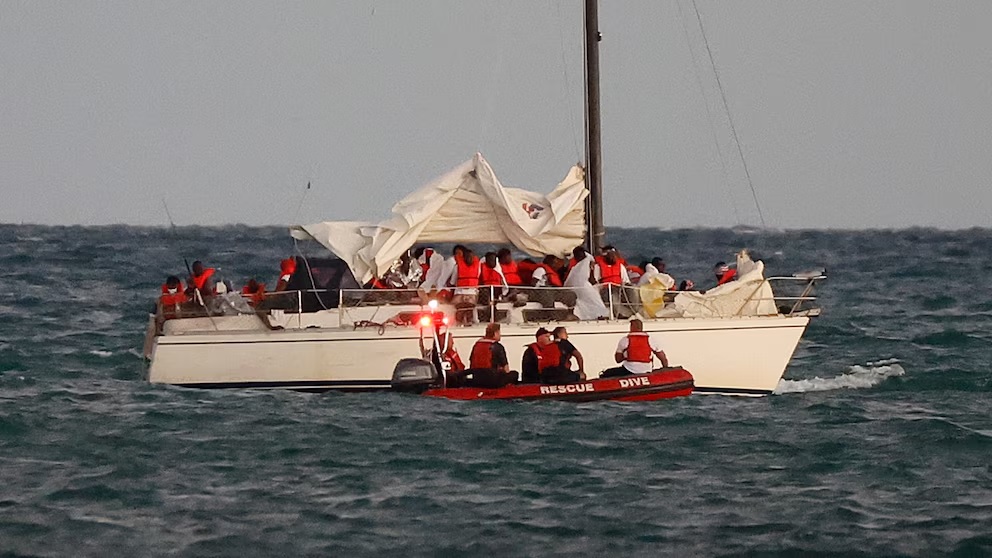
The recent attempt to illegally cross into the United States ended with the immediate return of most of the migrants to the Bahamas, where the boat is believed to have departed from. Four people—all men—were arrested on suspicion of serious crimes, reported the newspaper Listín Diario.
The interception, carried out by U.S. Customs and Border Protection (CBP), highlighted the risks and the diverse nationalities of those undertaking the perilous journey to the Florida coast.
U.S. authorities confirmed that 15 people were traveling in a boat without lights, detected in the early morning hours of March 11 near Miami.
Among the occupants were citizens of Panama, the Dominican Republic, Ecuador, and Haiti, including a child, five women, and several adult men. The Panamanian driver was identified as the person in charge of the vessel.
Following the intervention, 11 of the people on board were returned to the Bahamas, the country from which they had departed. Four others remained in U.S. custody, facing possible charges of human trafficking and illegal reentry.
To date, authorities have not specified the nationalities of those detained, who were turned over to Homeland Security Investigations (HSI).
In these cases, U.S. policy typically calls for the immediate deportation of undocumented migrants, while those identified as organizers or repeat offenders may face criminal prosecution.
The attempted sea crossing, exacerbated by navigating in darkness, increased the risk for all occupants and complicated the detection efforts of border agents.
Interagency Cooperation and Dangers of the Journey
The operation involved the participation of various federal and state agencies in the surveillance and subsequent interception of the vessel. Lauren Bis, acting assistant secretary of the Department of Homeland Security, stated, “Human smuggling operations at sea put lives at grave risk,” and emphasized the value of inter-agency collaboration to achieve effective results.
CBP warned that the maritime routes used by smuggling networks continue to pose a threat to both border security and the safety of migrants. According to the agency, the vessels often depart in precarious conditions and under the constant threat of capsizing, increasing the likelihood of tragedies during the crossing.
The composition of the intercepted group reflects the diversification of migration flows to the United States.
The recent case involved individuals from several Latin American and Caribbean countries, a trend that immigration authorities are observing with concern given the increase in similar operations in the region.
The thwarted attempt at a maritime crossing, detected in the middle of the night and under high-risk conditions, underscores the ongoing challenge for law enforcement. Maritime surveillance operations seek not only to prevent irregular entry, but also to prevent tragedies and dismantle human trafficking networks that exploit the vulnerability of migrants.