
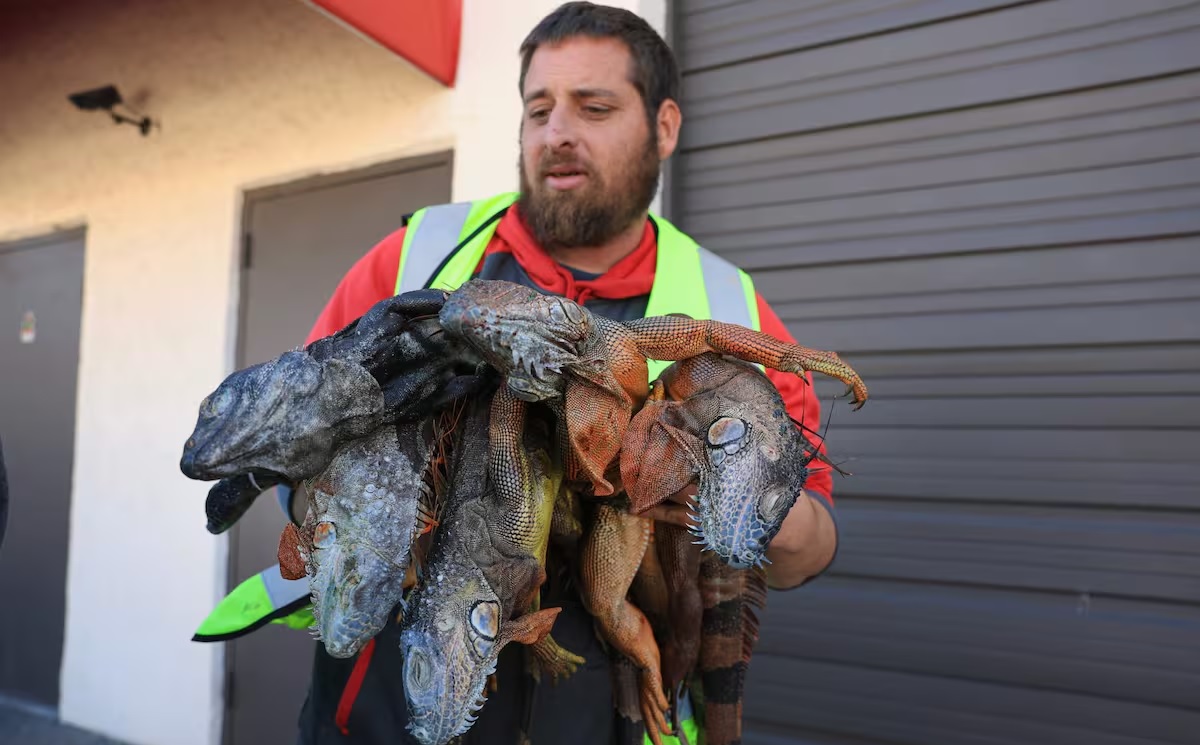
On the afternoon of Wednesday, February 4, the local government of the City of Miami, Florida, suggested that its residents humanely euthanize the iguanas that froze after the record-breaking cold snap in the state, as the Florida Fish and Wildlife Conservation Commission (FWC) received nearly 3,000 of these animals.
“We are no longer accepting green iguanas at FWC offices. Temporary regulations only allowed people to transport green iguanas to FWC offices on February 2 and 3. You can still humanely euthanize green iguanas on your property or with the owner’s permission,” the Commission stated on its social media.
The warning came after FWC Director Roger Young reported receiving 3,000 iguanas due to record-breaking cold weather in Florida, where Miami experienced its coldest start to February on record, with near-freezing temperatures and snow reaching the southern part of the state, a region usually characterized by heat and humidity.
This situation led to an “iguana rain” in Florida, a phenomenon in which the reptiles fall from trees as they freeze. As a result, the state government issued an executive order temporarily allowing residents to transport these live, but paralyzed, animals to the Florida Fish and Wildlife Conservation Commission (FWC) offices.
“Invasive green iguanas are not protected in Florida, except by state anti-cruelty laws, and members of the public may humanely kill them on their property or with the owner’s permission,” the FWC stated in a press release regarding the arboreal lizards, which can grow up to 5 feet (1.65 meters) in length from head to tail.
Faced with this situation, the Florida Fish and Wildlife Conservation Commission (FWC) also reminded the public that state laws prohibit people from owning or transporting these reptiles, as they are an invasive species, like some 600 other non-native species in the state of Florida, and have “adverse impacts on Miami’s environment and economy.”
The FWC also asked the Florida population not to bring these frozen iguanas into their homes or offices, explaining that these reptiles can recover “faster than people think” from the cold, and then act defensively, using their long tails like whips, as well as their sharp claws and teeth.
However, this phenomenon reflects the devastating effects of the cold in Florida, where the National Weather Service (NWS) issued freeze warnings that included Miami-Dade County, with record-breaking near-freezing temperatures, in addition to snow on the central and southern coasts of the state, such as Cape Coral, Tampa, and Sarasota.
Most iguanas in South Florida come from countries with warmer climates in Central and South America, where they don’t face such low temperatures. Therefore, these cold-blooded green iguanas rely on external heat to regulate their body temperature. However, everything changes when the cold weather arrives.
According to the American television network Telemundo, when the temperature drops below 10°C (50°F), some iguanas enter a state of hibernation that leaves them lethargic or immobile. To survive the cold, they slow down their bodily processes, including their heartbeat.