
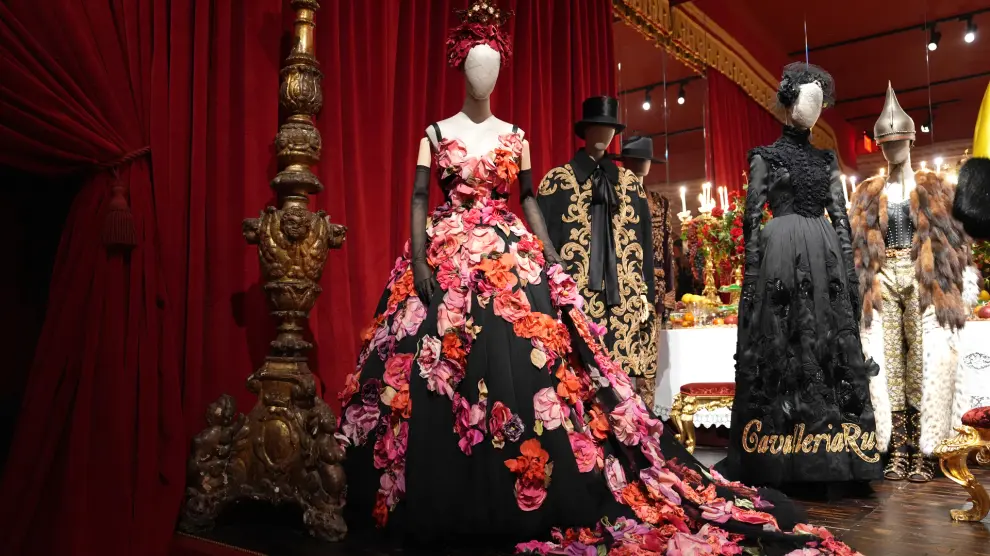
Papal vestments, extravagant collections, and exclusive designs that evoke the Baroque era and Milanese opera are some of the secrets of Haute Couture that, until now, have remained largely hidden. Dolce & Gabbana is showcasing these secrets starting this Friday at the Miami Institute of Contemporary Art.
The exhibition, titled “From the Heart to the Hands,” which will run until June 14, traces centuries of fashion design history through more than 300 pieces and archives that inspired the founders of the popular Italian fashion house, Domenico Dolce and Stefano Gabbana.
But in addition to dazzling, opulent, somber, and vibrantly colorful designs, the exhibition also dedicates a special place to the true artisans of fashion: the seamstresses, tailors, and dressmakers who work in the workshops.
“What’s wonderful about this exhibition is that we offer visitors the opportunity to see these works of art up close,” revealed the exhibition’s curator, Florence Müller, in an interview with EFE.
“Normally, this is kept secret in the world of haute couture, in private fashion shows to which no one has access, and then the dresses are locked away in the company’s closets and warehouses. But now they have the opportunity to discover all these pieces up close,” she added.
The exhibition immerses visitors in more than a dozen rooms that transport them through space and time, including the election of Pope Leo XIV.
A narrow corridor lined with mannequins on one side and dominated by a papal vestment at the far end replicates the Ponte Sant’Angelo in Rome, while a large screen on the right displays images of the current pontiff’s election.
Another room, crowned by a large mirror on the ceiling and surrounded by enormous paintings on the walls, combines dresses, coats, and suits made of silk, printed with images of the canals of Venice or references to Sandro Botticelli.
“What we would like is for visitors to understand how fashion and haute couture, haute couture, and fine jewelry can be full of artistic and cultural references,” said Müller.
Watches, gold-plated earrings, and extravagant handbags are ever-present along the sides of the exhibition, which in another room welcomes viewers with the rhythms of Sicilian music and a cascade of colors emanating from its walls and floor, all of which do not detract from the designs.
In between, the exhibition pays homage to the 1963 film ‘The Leopard’ with baroque costumes and sounds in a room that combines garments from the aristocracy and the bourgeoisie.
The exhibition concludes in another rectangular room representing the Milan Opera House, revealing the collections Dolce & Gabbana reserves for opera specialists.
Milan is one of the three cities the exhibition has visited before arriving in Miami, along with Paris and Rome.
“Miami is a city brimming with inspiration of all kinds, a city with a strong artistic presence. There are many art galleries, there’s Art Basel Miami. There’s also a lot of fashion, many trendy districts,” explained the curator.
She highlighted the “strong Latin influence” the city enjoys, which serves as a nod to the exhibition.
The curator also addressed the future of fashion design and the challenges it faces in an increasingly technology-driven world where artificial intelligence (AI) is rapidly gaining ground.
“I think we’re losing a bit of our humanity and what we’re capable of doing with our hands, and what we can achieve with our own human vision. Artificial intelligence is based on human vision, but the way it works is less spontaneous and fluid, and the spontaneity of haute couture is very important,” she asserted.
For Müller, a fundamental part of design and art is the unintentional mistake a human being makes, which a machine cannot replicate, thus bringing greater realism to the works.
“When we see something too perfect, it can sometimes be a little unsettling. We need some mistakes,” she said.
However, she didn’t completely reject the increasingly widespread use of AI, indicating that it should be limited to being “a tool to streamline and facilitate the entire process,” and to support the inspiration of designers.