
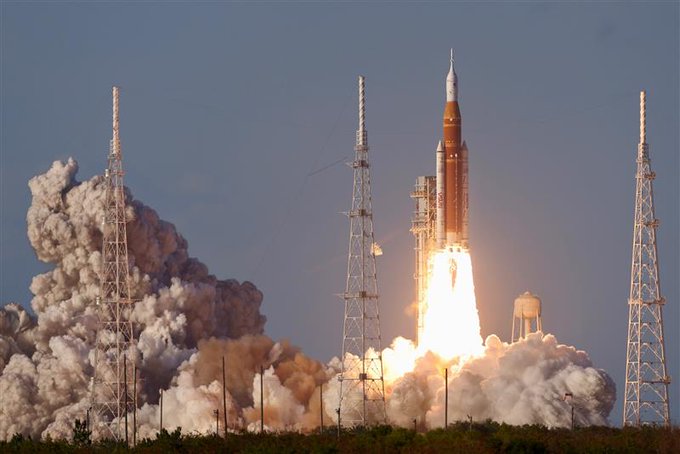
CAPE CANAVERAL — Four astronauts embarked on a high-risk flight around the Moon Wednesday, the first such mission for humanity in more than half a century and the exciting start of NASA’s push to return to the lunar surface within two years.
With three Americans and one Canadian aboard, the 32-story-tall rocket lifted off from NASA’s Kennedy Space Center, where tens of thousands of people gathered to witness the beginning of a new era. Large crowds also lined roads and nearby beaches, reminiscent of the Apollo missions in the 1960s and 70s. It is NASA’s biggest step yet toward its goal of establishing a permanent presence on the Moon.
Artemis II launched from the same Florida launch pad that sent the Apollo explorers to the Moon so long ago. The few who remain alive applauded the great adventure of this new generation as the Space Launch System (SLS) rocket rumbled through the sky, while a nearly full moon beckoned them from some 400,000 kilometers (248,000 miles) away.
Artemis II commander Reid Wiseman exclaimed, “We’re going to the Moon!” as he was joined in the Orion capsule by pilot Victor Glover, Christina Koch, and Canadian Jeremy Hansen. It was the most diverse lunar crew in history, including the first woman, a person of color, and a foreign national.
The four made hearts with their hands as they waved goodbye to their families before boarding the van that took them to the launch pad. “I love you guys,” Glover declared.
The astronauts will stay close to home for the first 25 hours of their 10-day test flight, checking the capsule as it orbits Earth before igniting the main engine that will propel them toward the Moon.
They won’t make a stopover or enter lunar orbit like the first Apollo 8 lunar visitors did on Christmas Eve 1968 while reading Genesis.
But they are about to become the humans who have traveled the farthest from Earth in history when their capsule speeds past the Moon and travels another 6,400 kilometers (4,000 miles) beyond, before turning around and heading straight home for a splashdown in the Pacific Ocean.
Once they have settled into orbit around Earth, the astronauts plan to take manual control of the capsule and practice maneuvering around the upper stage that separated from the rocket, even getting within 10 meters (33 feet) of it.
NASA wants to know how Orion behaves in the event of an autopilot failure and the pilots being forced to take over.
Four days later, during the lunar flyby, the Moon will appear about the size of a basketball held at arm’s length. The astronauts will take turns peering out of Orion’s windows with cameras. If the lighting is right, they should be able to observe features never before seen by the human eye. They will also capture part of a total solar eclipse, donning special glasses as the Moon briefly blocks sunlight from their perspective and the corona is revealed.
All of NASA’s lunar plans—a gradual increase in launches over the next few years leading to the construction of a sustainable lunar base for astronauts with the assistance of robotic vehicles and drones—depend on the success of the Artemis II mission.
It has been more than three years since Artemis I, the only other time NASA’s SLS rocket and Orion capsule have launched together. With no one on board, the Artemis I capsule lacked life support equipment and other crew essentials, such as a water dispenser and a toilet.
These systems are making their space debut on Artemis II, which increases the risk. That’s why NASA decided to wait a full day before sending Wiseman and his crew on a four-day journey to the Moon and another four days back.
“There has always been a lot at stake with this mission,” said NASA’s Lori Glaze before the launch. But mission teams have even more motivation now that the space agency has finally accelerated the pace of lunar launches, focusing on surface operations—as recently announced by the agency’s new administrator, Jared Isaacman.
Since half the world’s population hadn’t even been born when NASA’s 12 lunar walkers left their footprints in the lunar dust, Artemis offers a new beginning, said NASA’s chief of science missions, Nicky Fox, this week.