
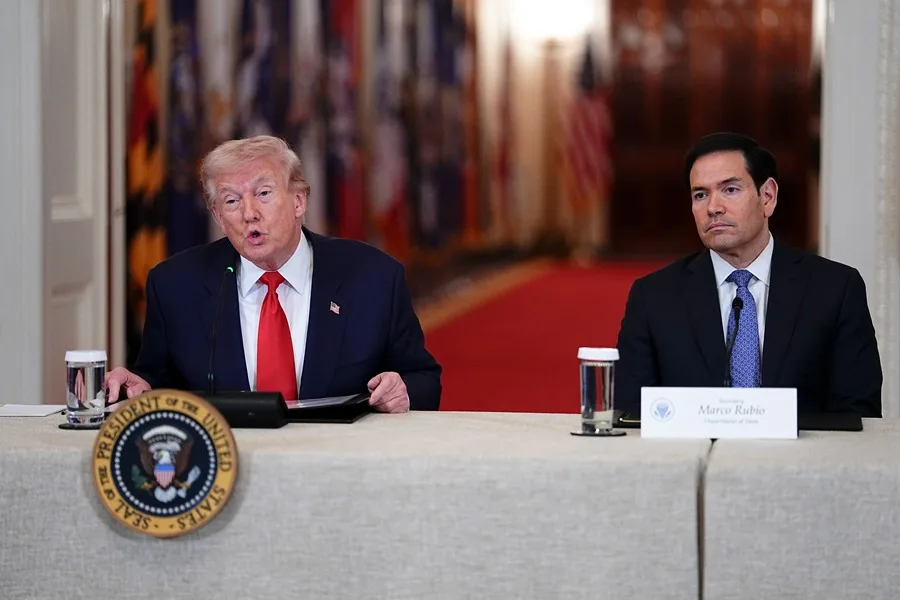
U.S. Secretary of State Marco Rubio testified Tuesday in a Miami court that he was unaware of an alleged multimillion-dollar contract that his friend David Rivera supposedly proposed around 2017 to bring the Venezuelan government of Nicolás Maduro closer to the United States and, among other things, facilitate a peaceful transition to democracy in that country.
The Cuban-born politician appeared today as a witness for the U.S. Attorney’s Office in a hearing for Rivera, a longtime friend with whom he even bought a home in Florida when they were both state legislators.
Rivera, along with Esther Nuhfer, is facing trial in South Florida, accused of attempting to influence the U.S. government to ease sanctions against the Maduro regime during Donald Trump’s first term, from 2017 to 2021, when Rubio was a senator in Washington.
For about three hours, Rubio was questioned by both the prosecution and the lawyers for Rivera and Nuhfer.
The Secretary of State asserted that he was unaware that Rivera had a contract with a U.S. subsidiary of the Venezuelan state oil company, which was seeking rapprochement with the Trump administration to ease sanctions and embark on a path to democracy.
However, Rubio acknowledged that in July 2017 he held two meetings with Rivera in which the former legislator presented him with a plan that, through businessman Raúl Gorrín—owner of Globovisión and alleged intermediary with the Maduro government—aimed to deliver a letter from the then-Venezuelan president to Trump proposing to initiate a peaceful transition process.
Rubio stated, however, that the second meeting, which Gorrín attended at a Washington hotel, was “a waste of time” because there was no letter of commitment from Maduro, which he was supposedly going to deliver to Trump.
He also admitted that, as supposed proof that Gorrín was financing the Venezuelan opposition and could be a valid interlocutor with Maduro, Rivera showed him on his computer an account displaying millions of dollars in transactions attributed to the businessman, now a fugitive from U.S. justice.
However, Rubio claimed he didn’t know who owned the account and didn’t ask Rivera about it.
The Secretary of State asserted that although he was “skeptical” that the Maduro government was truly opening the doors to a democratic process, he thought it was worth the effort for his friend, whom he had known since the mid-1990s.
The politician also mentioned two speeches he gave around the same time, one in the U.S. Senate in which, using “key” words provided by Rivera, he addressed the Maduro government and emphasized that there would be no “revenge” against the regime if they began a genuine democratic process.
The other speech was in Spanish, recorded in Washington for the Globovisión channel and broadcast in Venezuela.
Rubio also emphasized during the questioning that after the 2017 meetings, he received information from U.S. authorities that there was a threat against his life from Diosdado Cabello, one of the most powerful figures in Chavismo, who at the time held several positions in the Maduro government.
The U.S. politician, whose security was reinforced for several months, also recalled asking Rivera to investigate the extent of Cabello’s threat.
Meanwhile, Rivera and Nuhfer’s defense focused their questioning of Rubio on demonstrating that the political relationship between the three transcended the professional and had a close, even familial, character, something the Secretary of State confirmed.
Likewise, the lawyers insisted that the political ideals of both defendants, like those of Rubio, were against totalitarianism and in favor of democracy in the region, especially in Cuba and Venezuela, a point that Rubio also conceded. EFE