
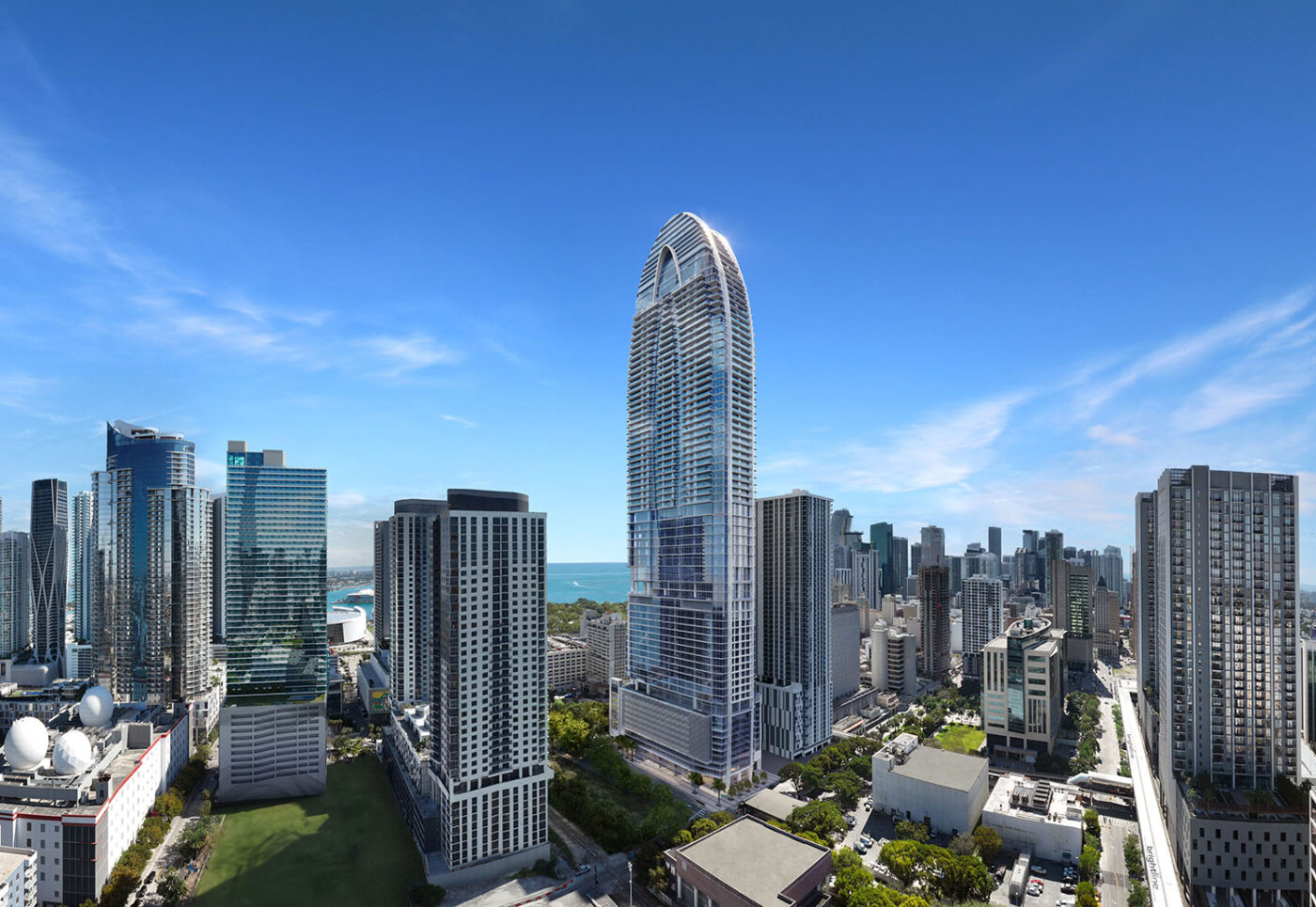
Miami is preparing to reshape its skyline once again. Downtown Okan Tower will become Florida’s tallest building, reaching nearly 908 feet, surpassing the Panorama Tower—868 feet and 85 stories—which has held the title since 2018.
The 70-story tower is slated to open in the second quarter of 2027 and targets the high-end market with a mix of hotel, condo-hotel, and luxury residences.
Developed by the Turkish Okan Group, the tower is distinguished by its curved silhouette inspired by a tulip, Turkey’s national flower. The project, with an investment of nearly $500 million, integrates several components:
Construction began in 2022 and reached its halfway point in October. According to Ana Povarchik of Fortune Development Sales, the tower will not only add prime inventory but will also have a symbolic effect: repositioning Miami’s skyline with a new architectural landmark and towering presence.
International Demand: Miami as a Safe Haven for Capital
The buyer profile confirms Miami’s role as a global investment destination. Approximately 80% of sales come from South America, with participation also from buyers in New York, Toronto, and Turkey.
The entry price reinforces its positioning in the high-end segment:
Sky residences starting at $1.25 million.
Hotel-condo units starting at $750,000.
To date, the developer reports 62% of the inventory sold and expects to maintain this pace as construction progresses.
For international investors, the appeal combines:
Location in downtown Miami, near Brickell, ports, and business hubs.
Condo-hotel model, allowing for personal use and rental under hotel operation.
Exposure to a market with strong demand for vacation and corporate rentals.
Amenities: Height, Experience, and Perceived Value
Okan Tower doesn’t seek to compete solely on height, but on experience. The tower will offer:
The highest rooftop pool in the United States.
A deck with bay views.
A fitness center, spa, and theater.
A wine cellar and exclusive lounge for owners.
For the luxury market, these types of amenities are not optional: they are part of the value proposition. They enhance the project’s pricing power, differentiate it from older inventory, and generate an aspirational narrative that drives sales and potential appreciation.
Miami is home to many of Florida’s tallest buildings, largely due to the absence of local height restrictions as stringent as in other markets. The main limit comes from the Federal Aviation Administration (FAA), which restricts heights to 1,049 feet to ensure safe air operations.
For developers, height translates into:
More units per lot.
Better views from higher floors, which justify premium prices.
Greater potential income per square meter of land.
Mayor Francis Suarez has pointed out that, in addition to financial logic, the ego factor also plays a role: the competition to build “the tallest” remains part of the symbolic game among developers and brands.
In this context, Okan Tower balances both elements: it stays below the FAA limit, but is tall enough to claim the title of tallest building in the state.
Implications for the Miami Real Estate Market
Okan Tower reinforces several key market trends:
Miami’s deepening as a global luxury hub, with strong Latin American demand.
Consolidation of downtown as a mixed-use center for housing, tourism, and business, complementing Brickell.
Competition among projects to differentiate themselves through design, height, and amenities.
For developers and investors, the project sends a clear signal: the market continues to reward central locations, well-designed products, and comprehensive hospitality and residential offerings, even in a more volatile global environment.
In the next decade, the question will no longer be simply who has the tallest building, but which towers manage to combine height, design, robust hotel operations, and a community of residents and investors aligned with Miami’s new profile: a global capital, a lifestyle hub, and a vertical city.