
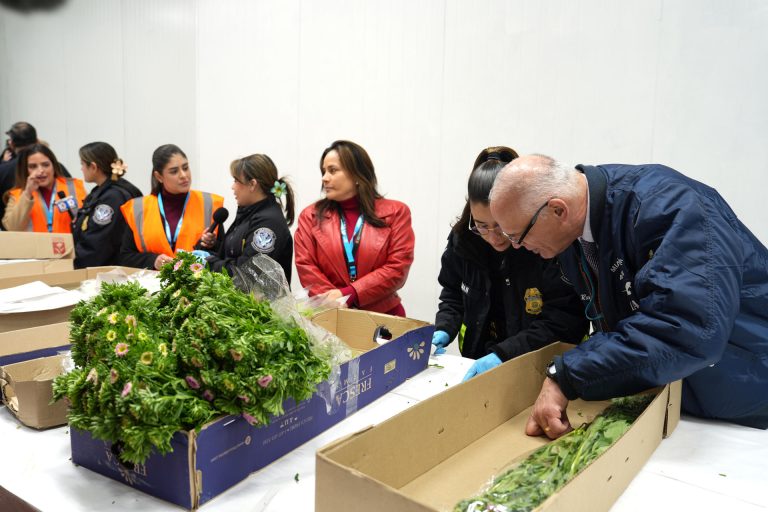
Flower imports rose 6% annually for Valentine’s Day, reaching a record 100,000 tons at Miami International Airport (MIA), which handles 91% of the flowers imported into the United States, after “surviving” the tariffs, local authorities indicated.
Flowers are the largest foreign product arriving at MIA, which also reported its sixth consecutive annual record for imported merchandise, following a 13.6% increase in 2025, when it processed 3.5 million tons of cargo, the airport’s CEO, Ralph Cutié, explained to EFE.
“It’s extremely important because 50% of the cargo that comes in is loaded onto other planes that then go to the rest of the country, and the other 50% is loaded onto trucks that also take it to other locations in the United States,” Cutié stated in an interview during a flower inspection demonstration.
The executive anticipates the arrival of 400,000 tons of flowers throughout the year, mostly from Colombia and Ecuador, at MIA. Nine out of every ten of these imported flowers arrive there before being distributed to the United States and Canada, making them the airport’s largest foreign cargo volume by weight.
Miami is the leading airport for international cargo, even more so than for passenger traffic. In contrast to the record cargo volume, passenger traffic has decreased by 1% annually, reaching 55.3 million in 2025, although it remains the second busiest airport in the United States for international tourists.
“This operation, and its economic impact, is extremely important for us and the rest of the community,” Cutié stated.
In the United States, Valentine’s Day is celebrated every February 14th and has become one of the most important commercial holidays of the year. The holiday drives a significant increase in consumption of flowers, chocolates, jewelry, and restaurant services, generating logistical peaks in the preceding weeks, especially in air cargo.
Flower statistics show that Miami International Airport (MIA) “survived the tariffs” that began in 2025, commented Raquel Regalado, commissioner for Miami-Dade County District 7, which oversees MIA.
“Last year was quite difficult; we didn’t know what was going to happen, whether we would continue investing or not, thinking that until we had to make a decision, we would keep moving forward. Thank God it didn’t have an impact,” Regalado told EFE.
The commissioner even anticipated an even greater increase, 9%, in flower arrivals for Valentine’s Day 2027, noting that the period around February 14th is the busiest time at the airport in terms of merchandise.
“Many people, when they think of the airport, think of human beings, but here cargo handles almost three times what human beings do, and it’s very important to our local economy,” he emphasized.
Most of the flowers that arrive at MIA, which also receives 60% of the fresh fruit and vegetables that enter the United States by air, come from Colombia and Ecuador, noted Daniel Alonso, acting regional director of Customs and Border Protection (CBP), at a press conference at the airport.
The main company transporting these flowers to the United States is the Colombian airline Avianca Cargo, which reported a 6% year-over-year increase in the flowers it ships. These flowers represent one out of every three Colombian plants that arrive in the U.S.
International cargo rose 13.6% annually in 2025 at Miami International Airport (MIA), the leading U.S. airport for foreign trade, marking its sixth consecutive annual record. However, passenger traffic fell 1%, airport authorities reported Friday.
The arrival of foreign cargo at MIA reached 3.5 million tons in 2025, but passenger traffic fell to 55.3 million, below the record of 55.9 million in 2024, when it grew 7% year-over-year, according to data from the airport, the second busiest for international tourists in the United States.
Despite the decline, airport officials argued in a report that the data shows “sustained demand” in Miami, citing that North America as a whole experienced a 2% drop in domestic travel in 2025, based on information from the Airports Council International.
In total, MIA handled 24.8 million international passengers and 30.5 million domestic travelers.
With information from EFE