
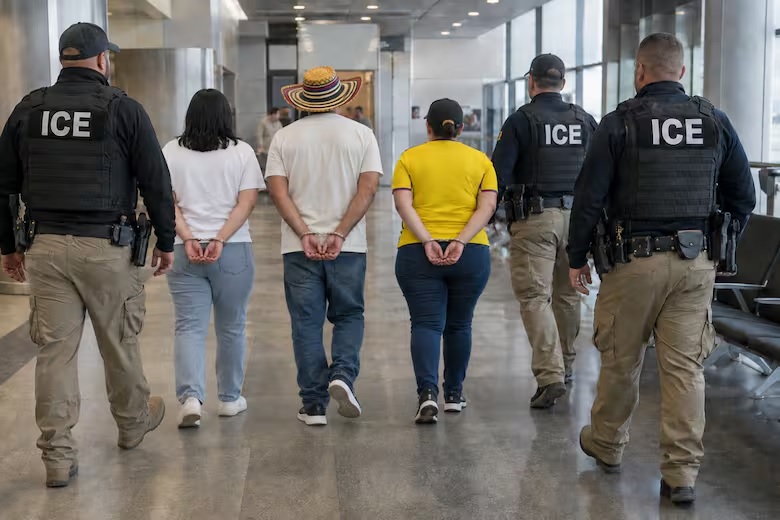
Immigration and Customs Enforcement (ICE) operations at U.S. airports have increased this year. California, Florida, and Texas appear to be linked to a strategy that utilizes passenger information, immigration checks, and transfers between detention centers.
Airports have become one of the locations used for arrests, especially due to information sharing between the immigration agency and the Transportation Security Administration (TSA).
According to data compiled by CNN, at least 127 arrests had been made at airports as of August 6.
In California, at least 11 Bay Area residents were arrested using this method.
Under other methods, raids resulted in nearly 50,000 arrests across the U.S. in July, including approximately 4,300 in California. According to the San Francisco Chronicle, records from the past 18 months show that the Golden State accumulated almost 50,000 arrests, compared to about 12,400 in the same period last year.
San Diego accounted for a significant portion of these arrests, with approximately 11,500 during the current administration. In that city, arrests rose from about 800 in June to around 1,500 in July.
San Francisco, meanwhile, saw at least 2,440 arrests. ICE operations also vary depending on state regulations.
In California, restrictions stemming from sanctuary state laws limit the cooperation of local authorities with immigration officials. For this reason, the federal agency resorted to locations such as airports and courthouses to carry out arrests with less involvement from local law enforcement.
One of the most recent cases mentioned is that of Ernestina “Tina” Pavlovsky, a 33-year-old Argentinian woman who lives in Aspen.
On August 1, she was arrested by ICE agents at a gate at Miami International Airport as she was preparing to return to Colorado after visiting family.
Pavlovsky had entered the U.S. legally on a tourist visa and had no criminal record. However, the Department of Homeland Security (DHS) maintained that this did not preclude considering that she had violated the conditions of her stay.
After her arrest, she was transferred to a detention facility in Florida. According to the Aspen Daily News, during her first few days she was held in Miramar, in a cell shared with 16 other women.
The Argentinian woman described the site as a “torture chamber” because the lights were kept on at all times, there was only one toilet in the middle of the room, and the detainees had to stand due to lack of space. According to her partner, Cody Kosinski, Tina remained there until August 4 and was then taken to the Broward Transition Center.
Although conditions at Broward are considered better by those around her, the transfers didn’t stop. In the middle of the night, the woman was put on a bus for eight hours.
Finally, she was transferred by plane to the CoreCivic Detention Center in Laredo, Texas, where she is currently being held.
“She will receive due process and will remain in ICE custody pending the resolution of her removal proceedings,” said a DHS spokesperson.
Pavlovsky’s case demonstrated how arrests made at airports can lead to transfers to other states.
According to her family, the Argentinian woman was handcuffed at the feet, hands, and waist and transported for more than 36 hours to a detention center in Texas.
Another case occurred on August 13, when a Colombian family was arrested at Atlanta airport before boarding a flight to Fort Lauderdale.
According to available information, they had work permits, driver’s licenses, and a pending asylum application, but were detained for overstaying their tourist visas.
Given this situation, immigration lawyers recommended caution with domestic air travel for certain individuals undergoing immigration proceedings. They also pointed out that a pending application or a work permit does not necessarily prevent detention by ICE.