
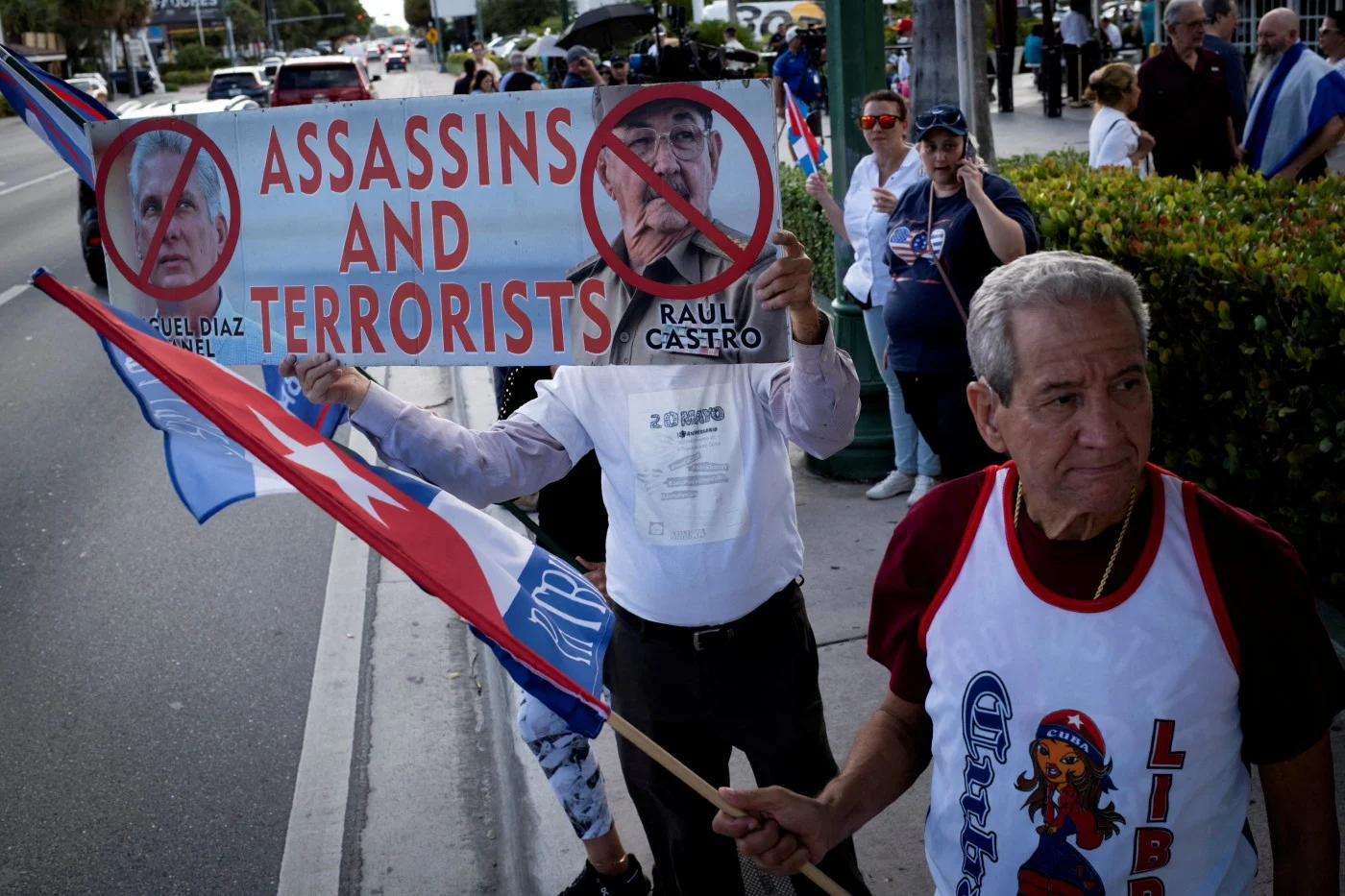
A group of exiles gathered this Wednesday outside the iconic Versailles restaurant on Miami’s Calle Ocho to celebrate the indictment of Raúl Castro, 94, and five other military officers for the 1996 downing of two Brothers to the Rescue planes (an incident that killed four people).
The charges against Castro, amid escalating pressure from the Trump administration against Havana, have drawn parallels with the strategy Washington used against Nicolás Maduro in Venezuela. This was noted by Cuban President Miguel Díaz-Canel in his reaction to the news, as well as by several of those attending the celebration outside Versailles.
“I think it’s something the people have been waiting for, and I think it’s also a strategy by the United States to have a legal reason to intervene in Cuba,” says Maribel Ramírez, 31, born in Havana and a resident of Miami for 15 years, who was wearing a red cap with the words “Make Cuba Great Again.” “At least we have hope, which was something that had been lost. Donald Trump has given the people hope again,” she adds.
Another participant in the demonstration who says she has more hope than ever is María Rodríguez, 62, who arrived from Cuba at age 5 in 1968 and was prosecuted with her family at the Freedom Tower. She says that “it was about time” that charges were brought against Raúl Castro. “I think it’s perfect. And the only thing I hope is that they really go and remove him,” like they did with Maduro. “We have a lot of hope that’s going to happen,” she says.
The gathering coincided with a rally organized by the Florida Republican Party in the restaurant parking lot, where county and city commissioners, election officials, and other local politicians took the opportunity to deliver speeches marked by a common tone of praise for President Donald Trump. Given the location and the occasion, the speeches were interspersed with messages against the Cuban regime and celebrations that, according to their interpretation, the United States was finally prepared to make those who attacked American citizens pay, even decades after the events.
Agustín Acosta, a former political prisoner carrying a sign with the faces of Díaz-Canel and Raúl Castro that read “Murderers,” says that some exiles had been planning to gather for some time to commemorate May 20th, and that the news of Raúl Castro’s prosecution took them by surprise: “That has made us even more hopeful,” he notes.
Since Fidel Castro came to power in 1959, the Cuban government gradually replaced May 20th, the date on which the Republic of Cuba was proclaimed in 1902. In its place, they promoted January 1st as the day of the revolution’s triumph, the main anniversary of national sovereignty.
“The Castro dictatorship made sure to erase this date, the date of the Republic, the date of independence,” Acosta points out. “In Cuba, I remember as a child the celebration of May 20th, which was a supreme joy. All Cubans celebrated it, the richest and the poorest. But the dictatorship absorbs everything, destroys everything, and controls everything. That’s the problem,” he adds. Now, May 20th has a different meaning.
A few hours earlier, the morning event at the Freedom Tower had brought together influential figures from the Cuban exile community and ended up becoming a kind of political and social gathering. In addition to family members of the victims of the downed Brothers to the Rescue planes, who occupied the front rows, leaders of exile organizations, Miami-Dade officials, administrators of the American Museum of the Cuban Diaspora, directors of Miami Dade College and FIU, as well as police chiefs and other local officials attended, chatting amid hugs and taking photographs, catching up.
One of them was Jorge Mas Santos, president of the Cuban American National Foundation, founded by his father, the historic exile leader Jorge Mas Canosa. “Today justice is served, in the name of the victims of the downing of the planes. For their families, it is a day of relief, and it is also a day to tell the world the truth about the Cuban regime,” Mas declared.
“We have endured seventy years with a totalitarian, repressive regime, but the most beautiful thing is that we are now experiencing days where we can see the end of the Castro regime with the leadership of President Trump,” he added.