
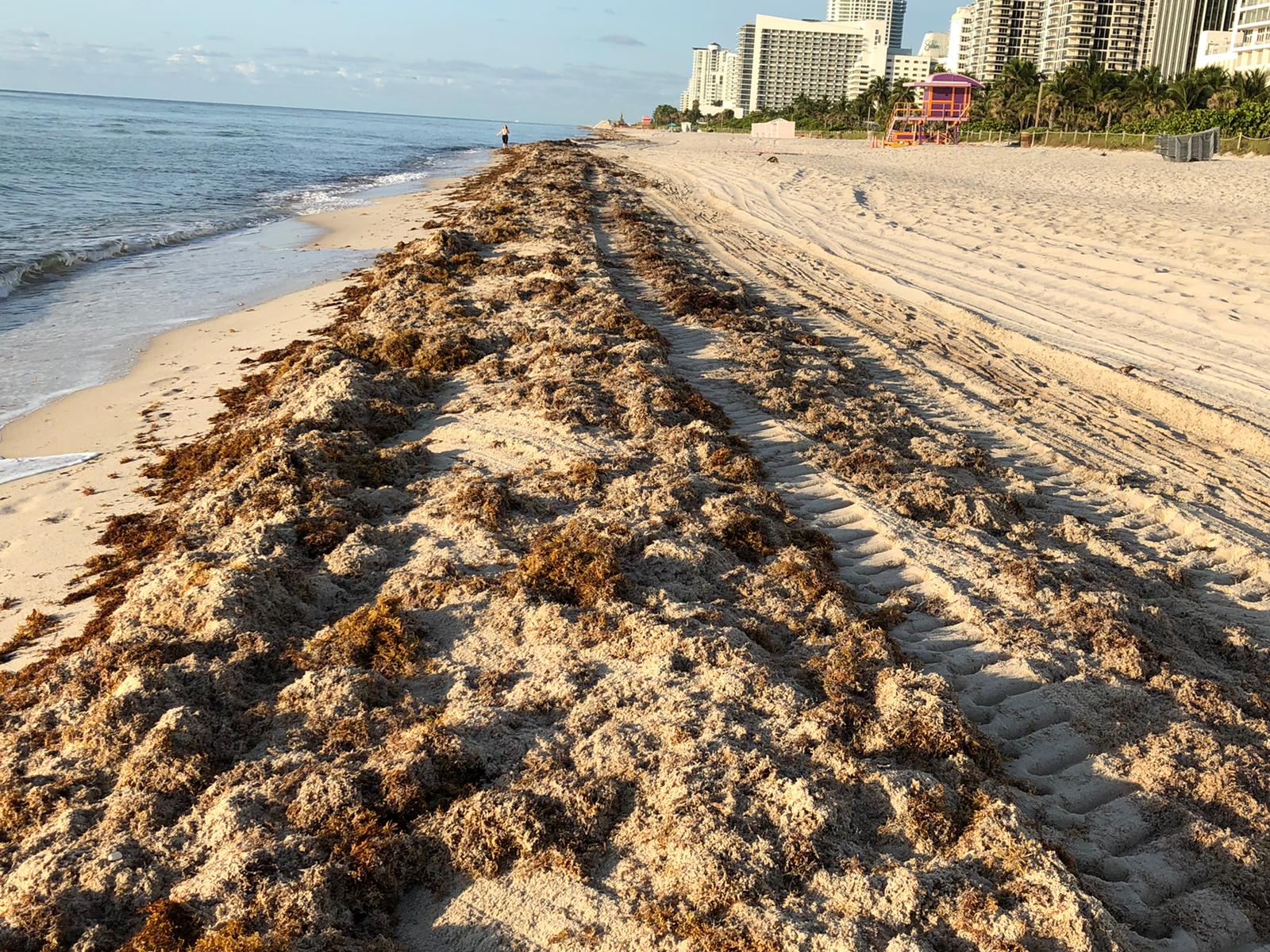
South Florida’s beaches are experiencing one of the most intense sargassum seasons in recent years. What began as the usual arrival of seaweed on the shores has transformed into a phenomenon of enormous proportions, already affecting vast areas of Broward, Miami-Dade, and other points along the state’s Atlantic coast.
Local authorities, environmental experts, and tourism businesses are watching with concern the advance of massive sargassum waves that continue to arrive from the Atlantic. The magnitude of the phenomenon has led some officials to describe it as a veritable “tsunami” of seaweed, an expression that reflects the unprecedented volume of organic material reaching the beaches.
The situation is also occurring at a crucial time for Florida’s economy. Summer marks the beginning of one of the most important seasons for tourism, an industry that generates billions of dollars annually and supports hundreds of thousands of jobs in hotels, restaurants, shops, and recreational activities linked to the sea.
In locations like Fort Lauderdale, Pompano Beach, Hollywood, Deerfield Beach, and other coastal cities, visitors have encountered an unusual sight: wide stretches of sand covered in accumulations of brown seaweed that, in some areas, reach several feet high.
Photos and videos shared on social media show extensive barriers of sargassum stretching along the coast. In certain areas, the amount of seaweed is so great that it hinders access to the water and significantly alters the experience for those who come to enjoy the beach.
For many tourists, especially those visiting Florida for the first time, the phenomenon is unexpected. Some have expressed surprise at finding conditions very different from the promotional images associated with the state’s beaches.
However, authorities insist that most beaches remain accessible and that municipal teams are working daily to minimize the visual and operational impact of the problem.
Beyond the aesthetic impact, one of the most bothersome aspects of the phenomenon is the strong odor that sargassum generates as it begins to decompose. Exposed to the sun and the high temperatures characteristic of Florida summers, the organic material releases gases such as hydrogen sulfide and ammonia. The result is an intense smell that many people compare to rotten eggs or decomposing organic matter.
In high concentrations, this odor can be perceived a considerable distance from the shore and affect the experience of residents, runners, cyclists, and tourists who frequent the boardwalks.
Although health authorities do not consider the detected levels to represent a significant risk to the general population, people with respiratory conditions, asthma, or chemical sensitivities may experience temporary discomfort.
On the other hand, it often bothers beachgoers, as was the case for Trish Currin, a tourist from Austin, Texas, who has visited the area on other occasions. “You don’t like it when it sticks to your leg. When we saw what it was like, my husband didn’t even want to come to the beach,” Currin commented.
The increase in sargassum is one of the most studied environmental phenomena in the Atlantic over the last decade. Scientists point out that multiple factors appear to be contributing to the expansion of this seaweed. These include warming ocean waters, changes in ocean currents, increased nutrients transported by large South American rivers, and alterations associated with global climate phenomena.
Since 2011, researchers have observed the formation of a gigantic floating mass known as the Great Atlantic Sargassum Belt. This structure stretches for thousands of kilometers between West Africa, the Caribbean, and the Americas.
Each year, some of this seaweed is carried to the coasts of the Caribbean, Mexico, and the southeastern United States. However, the volumes recorded in 2026 are among the largest observed since modern satellite monitoring began.
Record-breaking Sargassum in the Atlantic: What Scientists Reveal
Data collected by the University of South Florida and other research centers indicate that May 2026 saw one of the highest concentrations of sargassum ever recorded. Satellite images show vast expanses of seaweed floating in the tropical Atlantic and gradually moving toward the Caribbean and the U.S. coast.