
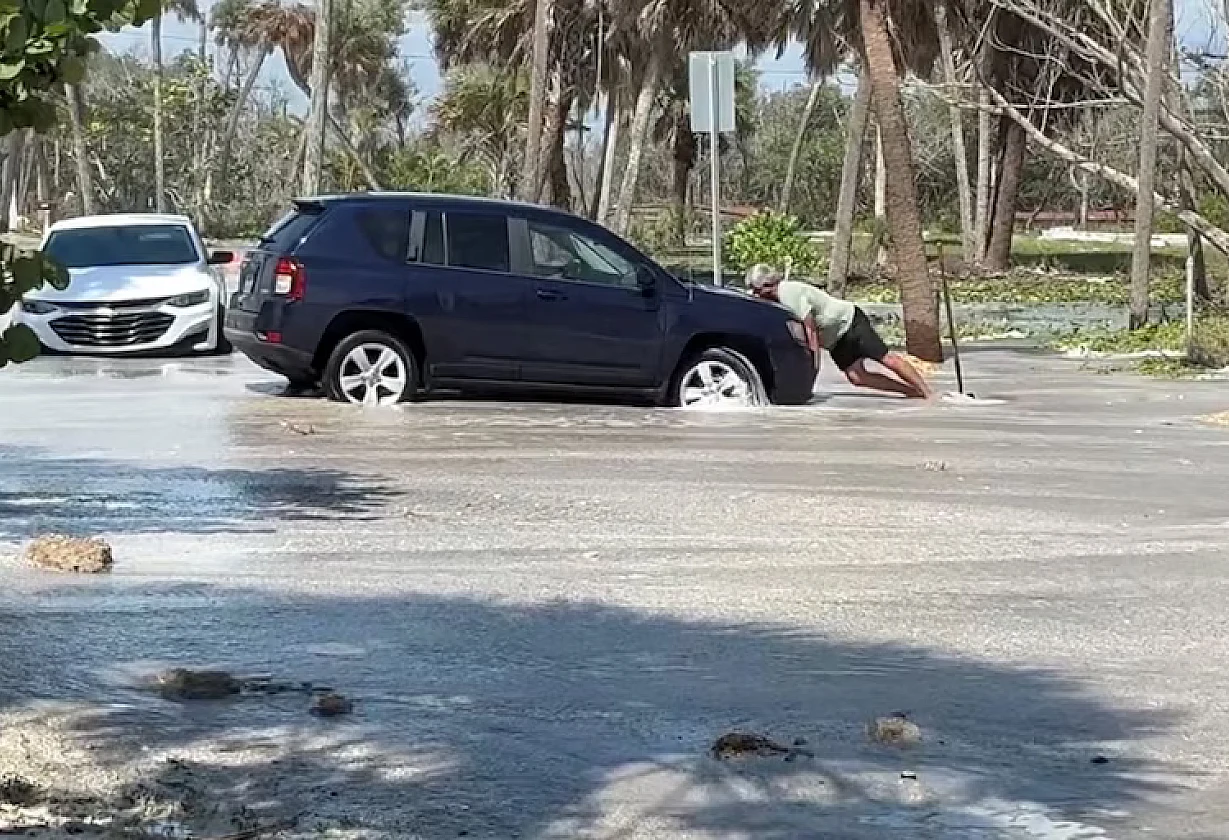
Isaias lost strength after making landfall Friday night near the Florida resort town of Destin as a Category 2 hurricane on the Saffir-Simpson scale, with maximum sustained winds of 165 km/h. The hurricane “has weakened very rapidly over Alabama and has become a post-tropical cyclone,” the U.S. National Hurricane Center (NHC) reported in its latest bulletin.
However, the cyclone could still bring heavy rains to southern Alabama, the Florida Panhandle, and Georgia, the center warned. The NHC forecasts that Isaias will move northward and then north-northeastward over the weekend, gradually dissipating as it crosses the Tennessee and Ohio valleys. Isaias is the first hurricane to make landfall in the continental United States since Milton in 2024.
The official Atlantic hurricane season runs from June 1 to November 30. Although tropical storms can form during that period, the first hurricane usually emerges well before October. The late appearance of Isaias in the Atlantic contrasts with activity in the Pacific, where several hurricanes have formed this year—including Polo, which reached Category 5, the highest level on the Saffir-Simpson scale.
Meteorologists attribute this difference to El Niño. This climate phenomenon typically fosters increased cyclone activity in the Pacific. In the Atlantic, however, it alters wind patterns in a way that hinders storm intensification and development into hurricanes. Isaias has left approximately 860,000 people without power across Florida, Georgia, and Alabama, according to the website PowerOutage.
Shortly before landfall, in Pensacola—located about 80 kilometers west of Destin—an AFP journalist witnessed strong winds tearing roofs off homes and businesses, snapping tree branches, and causing power outages.
Faced with the threat of destructive gusts, rough seas, and torrential rains, several states bordering the Gulf of Mexico—including Florida and Alabama—declared a state of emergency and ordered evacuations. President Donald Trump canceled a trip scheduled for Saturday to neighboring Alabama, where he was set to attend an American football game.
Several Florida airports temporarily suspended operations on Friday, and oil companies Chevron and Shell evacuated workers from various platforms. Nearly two-thirds of the region’s oil production and more than half of its gas production were halted on Friday, according to the U.S. Bureau of Ocean Energy Management. This represents a loss of approximately 1.5 million barrels of crude oil per day from the global market.
Isaias threatened a region home to numerous refineries, a situation that could exacerbate difficulties for a sector already under significant strain due to conflicts in the Middle East and Ukraine.