
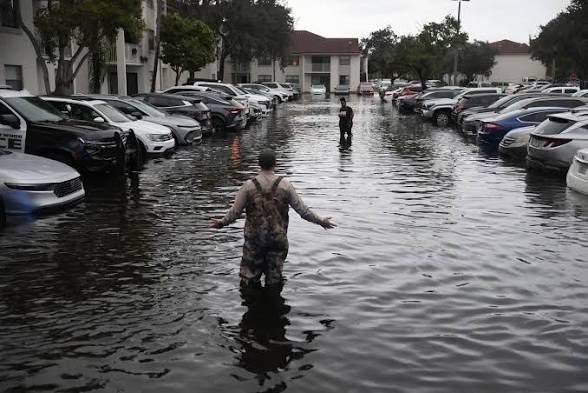
On Thursday, the St. Johns River—Florida’s longest river—surpassed a historic water-level record (set in 1953) near the city of Cocoa. Meanwhile, the storms that have inundated the state’s Atlantic coast are moving northward, threatening additional communities along a stretch of coastline spanning approximately 320 kilometers (about 200 miles).
Flood warnings issued by the National Weather Service (NWS) cover a stretch of about 320 kilometers, extending from south of Melbourne to the Jacksonville area.
Since Tuesday, November 17, parts of the East Coast have already recorded more than 43 centimeters (nearly 17 inches) of rain, according to preliminary NWS data. Several locations have already experienced their wettest November on record.
At the gauge located west of Cocoa, the river reached a level of 5.7 meters—more than 30 centimeters above the previous record of 5.36 meters, set in October 1953. The NWS projects that the river level will remain at least 60 centimeters above the flood stage until early next week.
“We are very concerned about the St. Johns. It is an incredible amount of water, and the river will continue to rise over the coming days,” said Will Ulrich, a warning coordination meteorologist with the NWS in Melbourne, in comments reported by the Associated Press.
The city of Rockledge has urged residents in its western sector—a flood-prone area—to prepare for evacuation while it is still safe to do so. Thousands of people in that area could be affected as water from days of heavy rainfall drains into the river and its associated lakes. Emergency response operations spanned the entire coast. In the Florida Shores neighborhood of Edgewater, police officers waded through knee-deep water, pulling a small boat to transport people to dry ground.
Further south, in Brevard County, authorities navigated flooded streets using airboats, following nearly 100 high-water rescues the previous day. In total, the county has carried out more than 200 rescue operations since the event began.
Nearly 200 members of the Florida National Guard, equipped with 50 high-clearance vehicles, were deployed along the coast, according to the state’s Division of Emergency Management. Other agencies, including the Florida Fish and Wildlife Conservation Commission (FWC), contributed approximately 235 additional personnel.
Brevard County Sheriff Wayne Ivey noted that it will take weeks for the water to drain completely. “The difficulty is that, as the St. Johns River reaches its crest, the water level isn’t going anywhere for a while,” Ivey warned in comments to WESH.