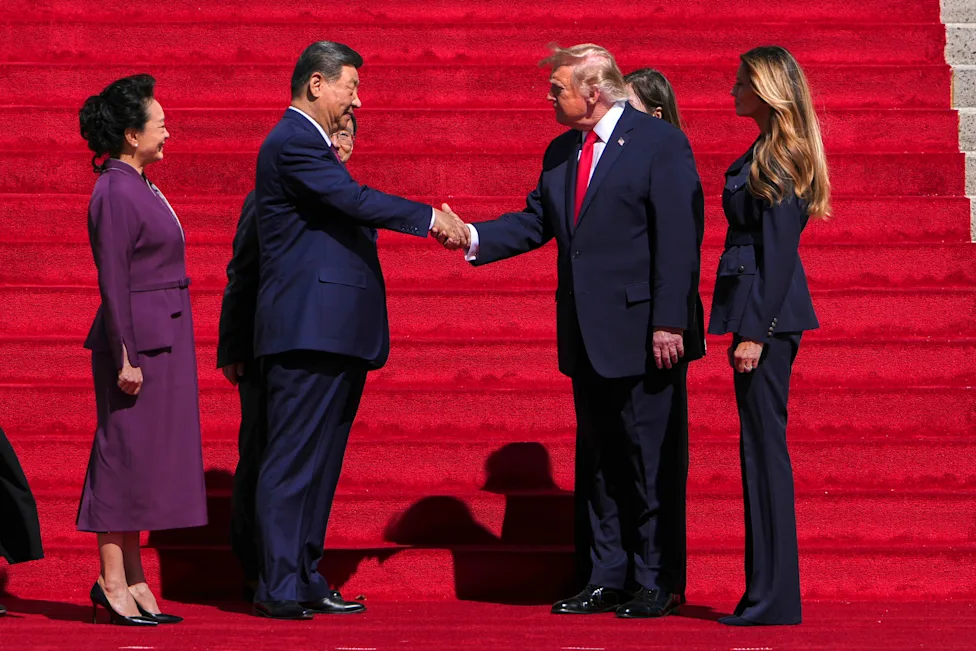
China and the United States have agreed to establish a dialogue channel regarding “superintelligence” to exchange views on the risks and benefits of artificial intelligence—a field in which both powers are engaged in strategic competition.
According to a White House statement released this Friday (September 25, 2026) regarding agreements reached during Chinese President Xi Jinping’s state visit to Washington this week, the next exchange under the “U.S.-China Dialogue on Superintelligence (SI)” will take place in November 2026; the two sides also agreed to set up a bilateral communication channel for incidents.
The text notes that both countries agreed to refer to this emerging technology as “superintelligence”—the term Trump used to rename artificial intelligence in his address to the UN General Assembly.
AI became a significant topic during the meeting between the two leaders, following Trump’s decision to disregard warnings from industry leaders about the need to regulate the technology due to fears that China might overtake the United States.
While the U.S. leader stated on social media that the technology should be “left as is,” Xi advocated during the meeting—as he had previously—for ensuring that it “remains under human control and benefits the population.”
Other agreements on coal, tariffs, and rare earths
On the trade front, the U.S.-China Trade Council and the U.S.-China Investment Council—established during Trump’s visit to Beijing in May 2026—were set in motion. It was also announced that China would import at least 10 million metric tons of coal from the United States in 2027 and again in 2028.
Additionally, both countries reached a consensus on recommendations to apply more favorable tariff treatment to $30 billion worth of non-sensitive goods in each direction. U.S. exports include agricultural products, timber, and cosmetics, while imports include household appliances and toys.
During the visit by both heads of state to the National Archives in Washington, the leaders examined the Declaration of Independence—which is marking its 250th anniversary—and the U.S. Constitution. Image: Kevin Lamarque/REUTERS
The statement also notes that both sides “will continue working” on U.S. concerns regarding Chinese exports of rare earth elements and critical minerals to the United States, “with the aim of ensuring that shipment levels return to adequate levels.”
The U.S. document—like the public statements made by both leaders—makes no mention of Taiwan. This is a sensitive issue for China; Xi had pressed Trump to explicitly reject the island’s independence—Beijing claims sovereignty over it—while the U.S. president continues to block a defensive arms package for Taipei, intending to use it as a “bargaining chip” in negotiations.
The text also notes that the United States urged Beijing to continue combating fentanyl chemical precursors and to increase the production of petroleum products to “stabilize global supply,” while Trump advocated for trilateral arms control negotiations involving the United States, Russia, and China.
Despite the emphasis on pomp and ceremony during the visit, the message from both the U.S. and Chinese sides was that the summit had helped ease tensions between the rival superpowers over various issues. Perhaps the visit’s main outcome was announced even before it took place: the extension of the trade truce until January.
The announcement that both leaders would continue their dialogue was, perhaps, the most important outcome of the meeting for both parties. Both leaders confirmed that they would meet again at the APEC summit in Shenzhen, China, in November, and at the G20 forum to be held in December at Trump’s resort in Doral (Miami).