
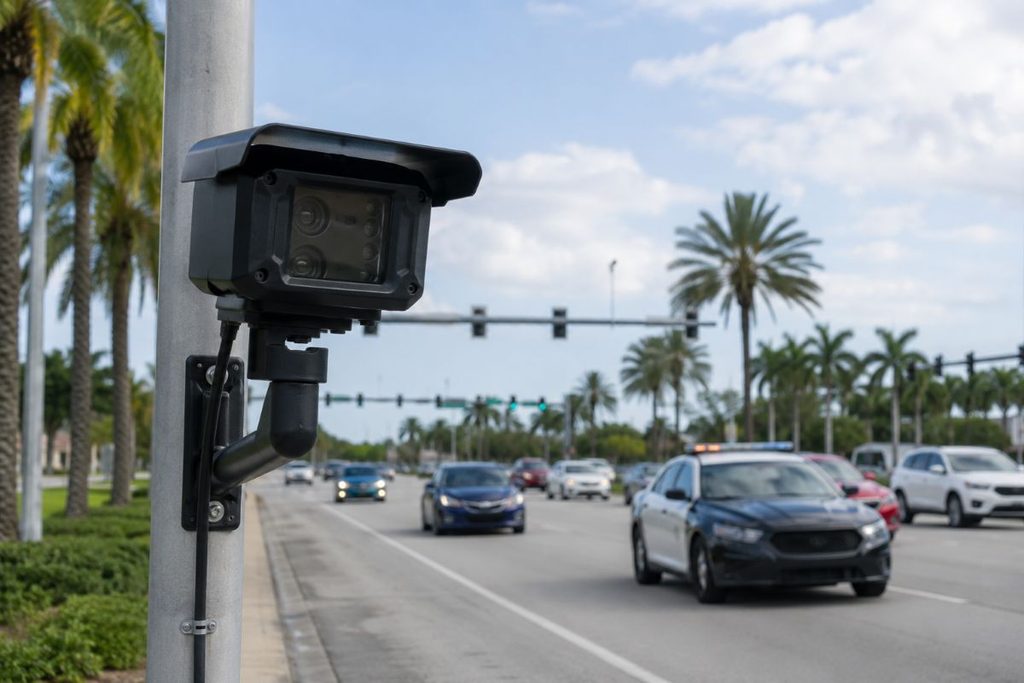
Florida Governor Ron DeSantis called for stricter regulations on Flock cameras, which identify license plates and store information about vehicles on the roads. He warned that their expansion could allow for the indiscriminate tracking of citizens who are not linked to any crime.
“I am all for law enforcement having tools to hold criminals accountable, but I don’t want this to turn into a surveillance state,” DeSantis said during an event held Wednesday, August 26, at Florida International University in Miami.
The governor acknowledged that these devices can be useful for locating stolen cars, missing persons, or vehicles related to criminal investigations. However, he maintained that their use has become “out of control” and urged Floridians to pressure their state representatives to establish legal limits. Find Local Guides
Flock Safety cameras are automatic license plate readers typically installed on poles along highways, at residential entrances, and in parking lots. Unlike traditional traffic light cameras, their primary function is not to issue tickets, but to record vehicles passing by.
The system captures the license plate, date, time, and location. It can also classify characteristics such as make, color, body type, and certain visible details of the vehicle. This information becomes a database that can be accessed by authorized agencies.
Flock maintains that its readers do not use facial recognition, that every search is logged, and that customers control access, sharing, and data retention periods. The company also announced that its recommended retention period would be reduced to seven days, although the specific settings may vary depending on the contract and the laws of each jurisdiction.
The critics’ concerns are not limited to a single photograph of a car. The presence of multiple cameras can allow investigators to reconstruct part of a person’s movements by linking the same license plate to different locations and times.
DeSantis suggested that Florida examine the restrictions implemented in New Hampshire, one of the states with the strictest limits on automated surveillance of public roads.
In that state, government use of license plate readers is subject to specific conditions. Records that do not produce certain matches must be deleted within a very short period, and there are broader prohibitions against fixed traffic surveillance systems.
New Hampshire law requires that license plate data be purged within three minutes, except when the reading leads to an arrest, a citation, protective custody, or allows for the identification of a vehicle linked to a wanted or missing person.
The governor did not present a specific proposal, but stated that his administration will review how state agencies are using these tools. He also linked the debate to his proposal to develop a Bill of Rights regarding artificial intelligence.
Florida law considers images and personal data obtained through automated license plate recognition systems to be confidential. It also establishes rules for their installation on certain roads and limits the retention of records to the period set by the corresponding state calendar.
However, current regulations do not amount to a blanket ban, nor do they resolve all questions regarding data sharing between departments, access by external agencies, the duration of records, and the circumstances under which searches can be conducted.
Criticism has increased in Broward, Tampa Bay, and other Florida communities. Some residents are demanding public audits, shorter retention periods, and court authorizations for certain uses. Others are directly demanding that local governments cancel their contracts.