
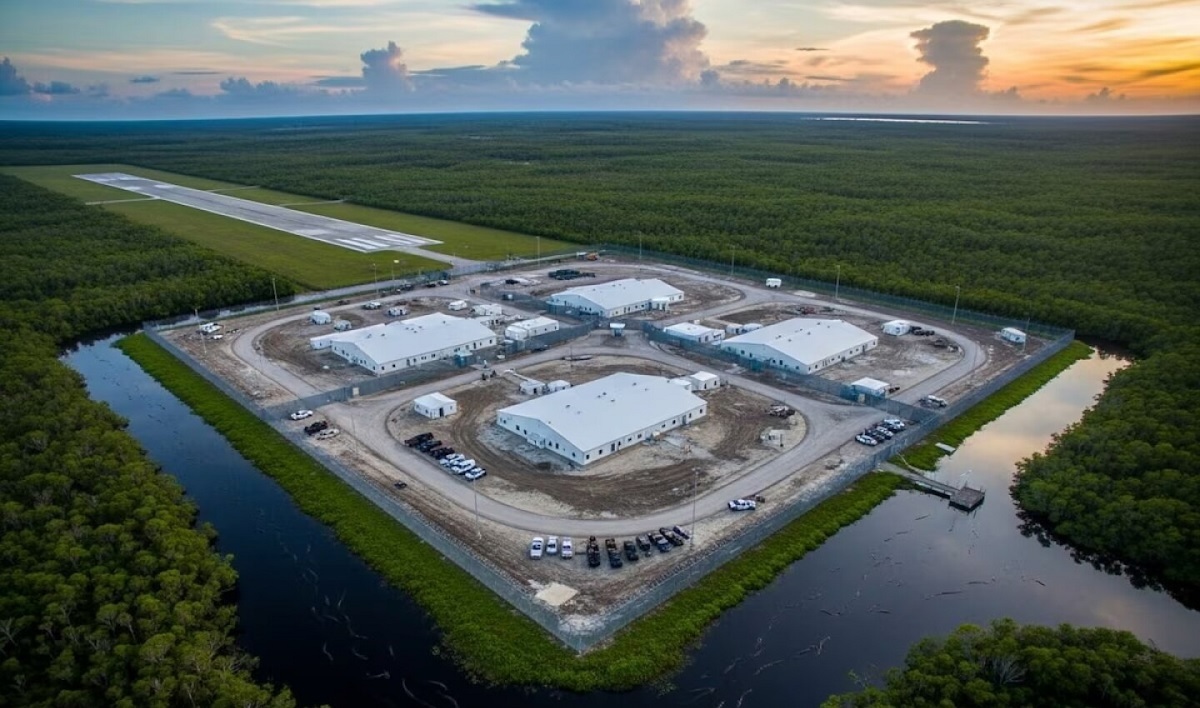
The state of Florida returned the land where the controversial ‘Alligator Alcatraz’ was built to Miami-Dade County this week. The immigration detention center became an emblem of President Donald Trump’s mass deportation campaign, and Trump inaugurated it in July 2015.
The center faced lawsuits from humanitarian and environmental organizations for the “mistreatment” of migrants and the environmental impact of the facility, located on a former airfield adjacent to the Everglades National Park ecosystem, a reserve protected by UNESCO as a World Heritage Site since 1979.
An inspection by both administrations detected damage to the runway and the surrounding area caused by the construction and operation of the center, the Miami-Dade County Mayor’s Office reported in a statement.
The county indicated that it expects the state administration of Governor Ron DeSantis, a Republican, to repair the damage to the land.
“From the beginning, I’ve been clear that this detention center should never have been built, and now we have the opportunity to shape a better future for this land,” said County Mayor Daniella Levine Cava in a video on X.
Local authorities are considering selling or transferring the nearly 10,000 hectares to the U.S. National Park Service or other entities working on wetland restoration, to ensure their permanent protection.
Florida closed the center at the end of June, a year after its inauguration, which was attended by President Trump.
Governor Ron DeSantis stated in June that the center “served its purpose” by facilitating nearly 30,000 additional deportations and that his state accounts for more than 40% of the nation’s immigration detentions.
The state government seized the airport, owned by the county, in June 2025 using emergency powers, after local authorities rejected a $20 million purchase offer.
The facility’s operation cost an estimated $1 million per day.
Civil rights and immigrant advocacy organizations denounced routine handcuffing, assaults by guards, prolonged isolation, overflowing toilets, and insect infestations. Amnesty International described these practices as “torture.”
The difficulties detainees faced in speaking with their lawyers also led a federal court to order that confidential communications be guaranteed.
Environmental groups and the Miccosukee Tribe, which inhabits the area, challenged the construction in federal court because it was built in a protected ecosystem without environmental review.
In 1970, the site was left unfinished with what was intended to be the world’s largest airport, a project halted by opposition from scientists and environmentalists. EFE