
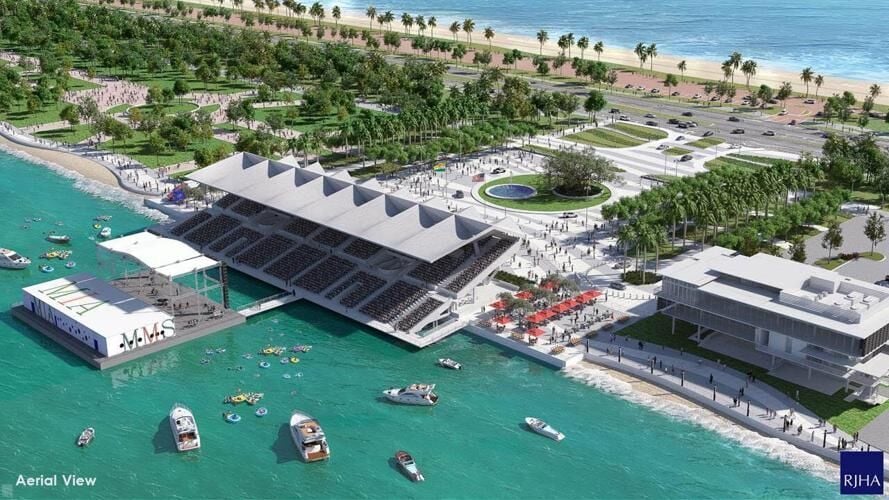
The future of Miami Marine Stadium will be decided on August 18, when Miami voters will decide in a special election whether the city should sign a long-term agreement to operate and reactivate the venue, which has been closed since 1992. The vote could pave the way for a restoration estimated at $65 million.
The referendum asks whether the city should authorize a management contract with Global Spectrum L.P., a subsidiary of Oak View Group, to operate and manage events at Historic Miami Marine Stadium and Flex Park, located at 3501 Rickenbacker Causeway. The decision will be made at the ballot box and will determine whether the project moves forward under the proposed terms.
According to the wording of the election materials, the agreement’s financial structure allocates 93% of the gross revenue from all events to the city, after deducting a monthly management fee of $33,333, in addition to 85% of sponsorship revenue. The same proposal stipulates that the operator contribute up to USD 10 million for the stadium’s restoration.
Councilman Damian Pardo told the media outlet that the renovation “is estimated at around USD 65 million” and that it could take approximately five years for the project to generate enough revenue for the city to move to the next phase of construction.
In this proposal, the August 18 referendum appears as the turning point that will enable—or halt—the long-term operating agreement and, consequently, the possibility of reactivating a space that currently remains unused.
If the plan moves forward, the stadium and the adjacent park would be under private management once the restoration is complete, according to the proposed scheme.
The stadium has been closed since Hurricane Andrew in 1992.
A crowd sits in an open-air stadium facing a bay with boats. Next to it, a stage with a striped roof and a group of people.
During that period, much of its surface was covered in graffiti, while the debate about its restoration remained open.
Before its closure, the venue had hosted concerts, regattas, boxing matches, and community events for decades. Part of that history includes a sold-out concert in 1985 where Jimmy Buffett dove into the water from the stage, an event that became synonymous with the place.
The stadium also appeared in the film Clambake, starring Elvis Presley and released in 1967.
The building was constructed in 1963 by Cuban-American architect Hilario Candela. Its design was distinguished by a cantilevered concrete roof and seating that extends directly over Biscayne Bay, a feature that made it a waterfront structure.
The closure in 1992 marked the beginning of a period of neglect that lasted for more than 30 years. During that time, the stadium remained without regular activity and deteriorated, while various initiatives sought to revive the idea of its restoration.
The heritage campaign paved the way for restoration. The impetus to preserve the venue came from Don Worth, a conservationist and co-founder of Friends of Miami Marine Stadium. Worth spearheaded a campaign to obtain historic landmark status and secure funding for the site.