
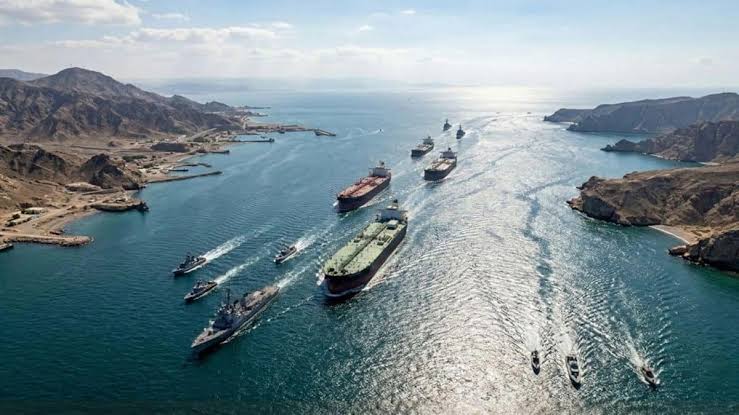
Three months after first implementing it, US President Donald Trump announced on Monday the reinstatement of the maritime blockade on Iranian ports.
“The Strait of Hormuz is open and will remain open, with or without Iran. We are reinstating the Iranian Blockade, so called because it only prevents ships from Iran or its clients from entering or leaving. All other countries will have fair and open access to the Strait,” Trump wrote in a message on his social media platform, Truth Social.
Furthermore, he indicated that Washington will provide protection to ships transiting the Strait of Hormuz, but in return will begin charging them a fee equivalent to 20% of the value of their cargo.
“From this moment forward, the United States will be known as ‘the guardian of the Strait of Hormuz’; but, as such and as a matter of fairness, it will receive compensation equivalent to 20% of all cargo transported, to cover any and all costs necessary to fulfill the task of providing security and protection in this highly volatile region of the world. The process and its implementation will begin immediately,” he wrote.
The reimposition of the blockade on Iranian ports comes almost a month after the US lifted the measure following the announcement that the US and Iran had reached a ceasefire agreement in the war that has pitted them against each other since the end of February.
On June 14, the Pakistani government—which acted as mediator between the parties—announced that an agreement had been reached, and a few days later both governments signed a Memorandum of Understanding (MoU) under which they would negotiate a final agreement to end the war within 60 days, extendable by mutual agreement.
Navigation through the Strait of Hormuz, through which approximately 20% of the world’s oil regularly passes, was disrupted from the start of the war launched by the US and Israel against Iran in late February, which claimed the life of Iran’s then Supreme Leader, Ali Khamenei, among its first casualties.
In response to this offensive, Iran began launching attacks against US-allied Gulf states, as well as against commercial vessels transiting the Strait of Hormuz, leading to a virtual standstill of maritime traffic through that waterway.