
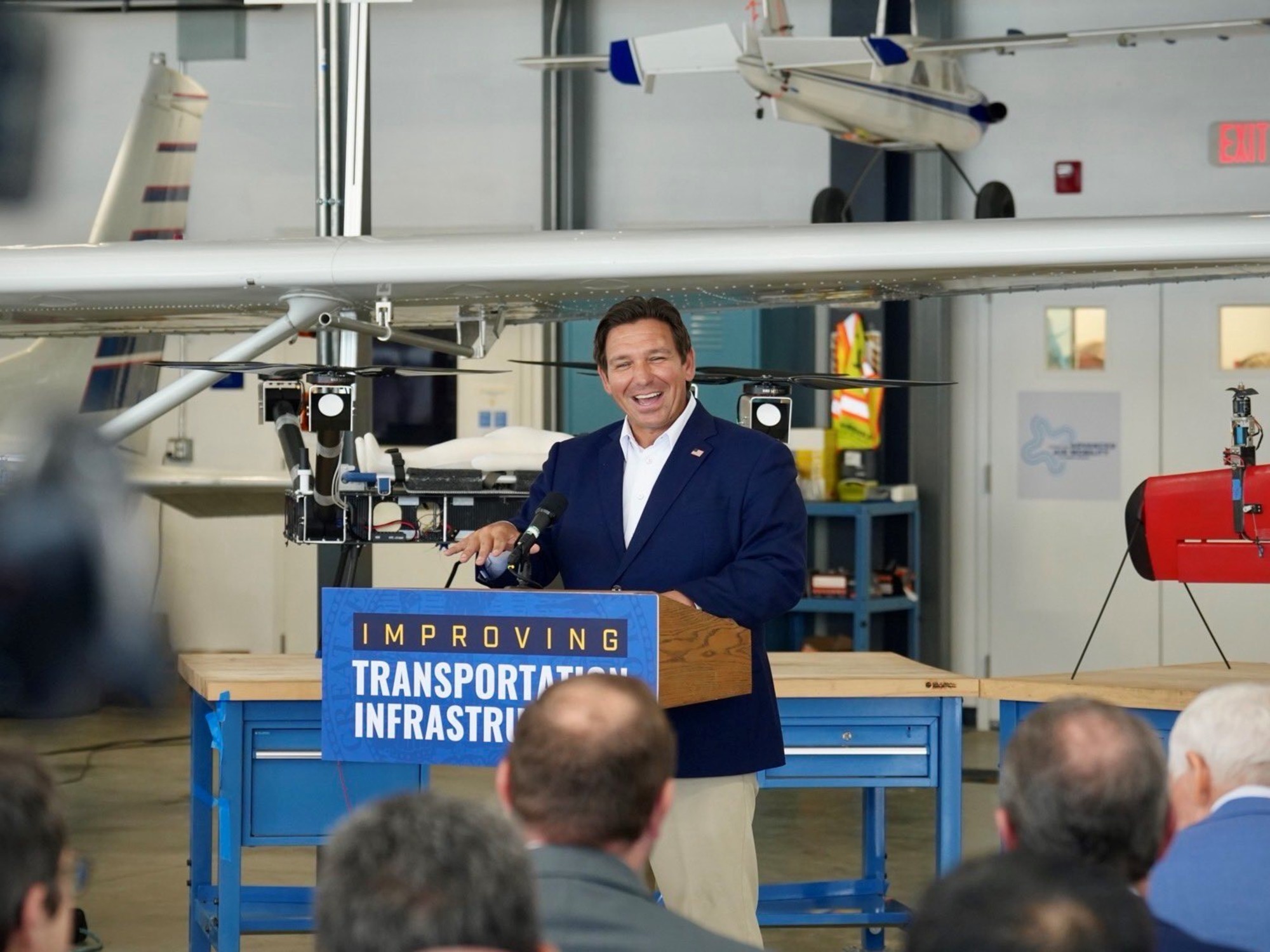
Construction on Clyde Morris Boulevard in Daytona Beach will be completed two years ahead of schedule, according to Florida Governor Ron DeSantis. The project will improve access to Embry-Riddle Aeronautical University and represents a $56 million investment.
“Improvements to Clyde Morris Boulevard have been a top priority for this region for years,” said Florida Department of Transportation (FDOT) Secretary Jared W. Perdu. He added, “Accelerating this project by two years will bring essential safety improvements to a vital corridor for Volusia County, Daytona Beach, and the university.”
These improvements highlight the ongoing strong collaboration between the university and the State of Florida, as well as Volusia County and the City of Daytona Beach, which also extends to research and workforce development for Advanced Air Mobility (AAM) projects.
The work on Clyde Morris Boulevard, or State Highway 483, is being carried out in three phases. The first phase runs from Richard Petty Boulevard to International Speedway Boulevard; the second, from Aviation Center Parkway/Bellevue Avenue to Richard Petty Boulevard and from International Speedway Boulevard to Mason Avenue; and the third, from Beville Road to Aviation Center Parkway/Bellevue Avenue.
According to the Florida Department of Transportation (FDOT), the project will be completed in 2029, two years ahead of schedule, after three years of construction. The FDOT adds that the work is designed to improve safety for drivers, pedestrians, and cyclists, as well as to promote more efficient traffic flow.
The work includes:
Constructing a pedestrian tunnel near the entrance to Embry-Riddle Aeronautical University.
Adding a 14-foot-wide multi-use path on the west side of Clyde Morris Boulevard and 8-foot-wide sidewalks on the east side. Install piping and fill the existing open channel near International Speedway Boulevard to create space for the new multi-use path.
Construct a pedestrian crossing on Buccaneer Way.
Improve roadway lighting.
Upgrade traffic signals.
Improve drainage.
Because transportation has a direct impact on quality of life, Florida continues to advance infrastructure projects. Moving this project forward by two years will allow essential community improvements to be made more quickly along this high-traffic pedestrian and tourist corridor, DeSantis said.
In addition to announcing the acceleration of the work, which will begin this fall, DeSantis highlighted the benefits of AAM technology, which is exploring new options for air taxis, cargo delivery, medical transport, and emergency response.
Florida’s investment in AAM reflects the state’s vision to alleviate congestion with new travel options, strengthen the state’s supply chain, and support a safe and efficient travel experience for residents and visitors.
To ensure progress in the deployment of AAM, the State partnered with Embry-Riddle to conduct fundamental research. In addition, institutions such as Embry-Riddle and Polk State College will contribute to the development of training and certification opportunities for the next generation of pilots, maintenance technicians, engineers, and other transportation professionals.